 Cash App tag:
 Marriage Class – Love Languages prt. 3


Guarding the Love Tank: Shifting Seasons, Honest Conversations, and Christlike Service
Welcome back to our recap of the Greater Friendship Marriage Enrichment Class! In our third session, our church family dug into the practical and spiritual mechanics of how we give and receive love. It is one thing to know intellectually that your spouse loves you, but it is an entirely different matter to actually feel it when life gets overwhelming.
From premium love language assessments to transparent discussions about feeling like “leftovers,” this week’s session challenged us to look inward, communicate with radical honesty, and view our relationships through the lens of Christ’s sacrificial love.
Here is your breakdown of the core insights and strategies from Session 3.
Scriptures for Reflection
To anchor this week’s study in the infallible Word of God, meditate on these truths regarding sacrificial love, honest communication, and Christ’s ultimate pattern of service:
Christ’s Model of Sacrificial Love
Ephesians 5:2
And walk in love, as Christ also hath loved us, and hath given himself for us an offering and a sacrifice to God for a sweetsmelling savour.
Love Expressed Through Action and Service
1 John 3:18
My little children, let us not love in word, neither in tongue; but in deed and in truth.
The Call for Honest and Building Speech
Ephesians 4:25
Wherefore putting away lying, speak every man truth with his neighbour: for we are members one of another.
Putting the Needs of Your Spouse First
Philippians 2:3–4
Let nothing be done through strife or vainglory; but in lowliness of mind let each esteem other better than themselves. Look not every man on his own things, but every man also on the things of others.
1. The Evolution of Our Love Languages
Many participants discovered that their primary and secondary love languages heavily favor Acts of Service and Quality Time. However, one of the most profound realizations was that these profiles are not set in stone—they change as our families grow.
- The Post-Children Shift: Alex Davidson shared that while Quality Time was initially her primary language, the arrival of children drastically elevated the importance of Acts of Service and Physical Touch.
- A Common Bond: Liandra Cash and Landon Davidson similarly identified Quality Time and Acts of Service as their top-tier languages. Landon even noted that practical expressions of love are so universally vital that Acts of Service might very well be the globally dominant love language, mirroring many biblical examples.
- No Hierarchy in Love: Pastor Larry Davidson brought us back to a foundational truth: every love language holds equal value. No single language is superior or inferior to another; they are all valid ways to mirror the heart of God.
2. Knowing Love vs. Feeling Loved
We crossed into some deeply transparent territory when discussing the gap between an intellectual awareness of love and our actual emotional reality.
Surviving “Life’s Tornado”
During high-stress parenting moments or exhausting work weeks, standard expressions of love can easily get lost. Alex Davidson noted that a husband’s acts of service don’t always register as love when a mother is entirely overwhelmed. Amber Davidson beautifully described this state as being caught in “life’s tornado,” a place where it becomes incredibly difficult to recognize a partner’s efforts. Liandra Cash also echoed the quiet struggle of trying to feel prioritized when raw exhaustion sets in.
The Trap of Keeping the Peace
To bridge this gap, Reverend Larry Davidson issued a direct challenge to the room, particularly targeting our natural tendency to avoid conflict.
Pastoral Insight: Men frequently choose to withhold their true feelings and needs simply to “keep the peace”. However, this false peace only leads to prolonged dissatisfaction and emotional suffering.
True marital growth requires radical, loving honesty. We must speak up about what we need so our spouses aren’t left guessing. Furthermore, Alex reminded us that Quality Time requires undistracted presence. Simply sitting in the same room scrolling on separate phones is not quality time; it requires focused, intentional attention to truly fill an emotional need.
3. Understanding the “Love Tank” Dynamics
The class heavily utilized the metaphor of the “love tank” to diagnose the health of our relationship dynamics.
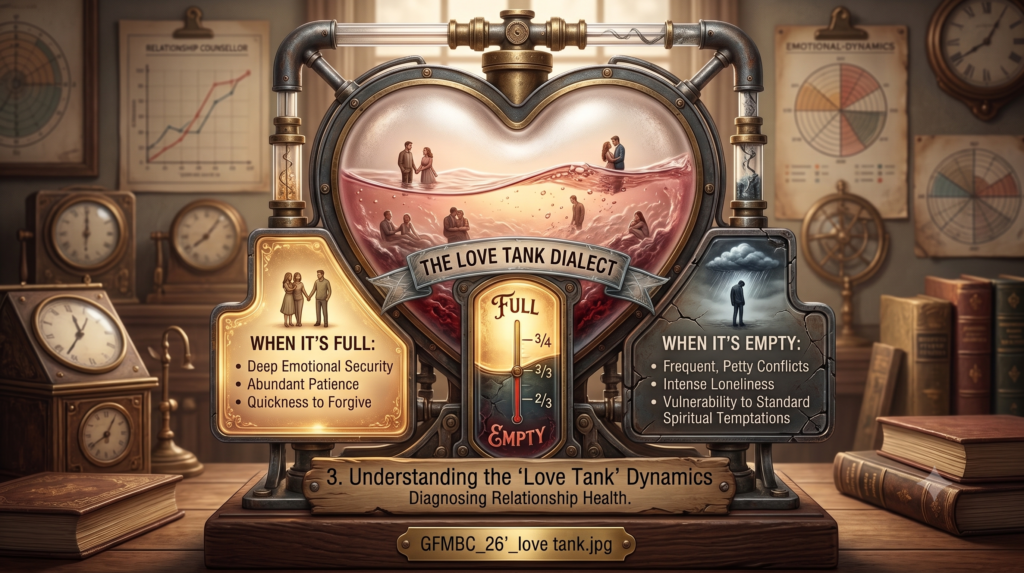
As Lorraine Davidson explained, a deficit in the love tank naturally breeds irritability and constant dissatisfaction. When the tank is dry, tiny issues suddenly turn into major blowouts.
Our needs run dry for a variety of reasons: adjusting to family routines, feeling disrespected, or dealing with broken promises. Lebbaeus Davidson reflected on how easily the thrilling excitement of early dating can fade into the monotony of daily routines if we aren’t careful. Lorraine candidly recalled seasons where she felt like she was getting the “leftovers” of her husband’s demanding pastoral schedule.
The Remedy: Pastor Larry emphasized that maintaining the love tank is a shared, active responsibility. You cannot simply sit back and wait for your tank to be filled. It requires sacrificial love—deliberately stepping outside your personal comfort zone to fill your spouse’s tank because you care about their security.
4. Reconciling Love Languages with the Spirit
The session featured a wonderful theological dialogue sparked by Lady K, who brought a healthy dose of spiritual skepticism to the table. She questioned whether relying too heavily on human love languages might complicate our primary spiritual commitments, urging the class to anchor themselves in God’s unchanging, perfect love rather than trying to constantly chase shifting human desires.
Pastor Larry beautifully harmonized this by connecting the two concepts. Love languages are not a replacement for scripture; they are simply practical expressions of it. At their core, every single aspect of a Christian marriage is spiritual. In fact, if you look closely at the Gospels, Jesus perfectly modeled all five love languages through His words of affirmation, His undistracted quality time, His gift of salvation, His ultimate acts of service, and His healing touch.
📦 Homework & Action Items
To ensure we are turning these lessons into real-world transformation, please take note of this week’s assignments:
- Read Chapter Two: Lorraine Davidson requests that everyone read chapter two of The Five Love Languages before our next session to keep our momentum moving forward.
- Private Conversations: Couples are highly encouraged to step away from the distractions of the week and have an honest, private talk about the current state of their love tanks.
- Conduct a Root-Cause Check: Take time for self-examination. If you are feeling lonely, irritated, or frustrated, reflect deeply on why you feel that way before addressing your spouse, focusing on managing your own response.
- Practice Radical Honesty: Stop staying silent to keep a fragile peace. Wives and husbands alike need to clearly and specificially communicate their emotional needs to prevent distance from widening.